

19 Jul Choosing the Right Business Security System: Commercial vs. Small Business
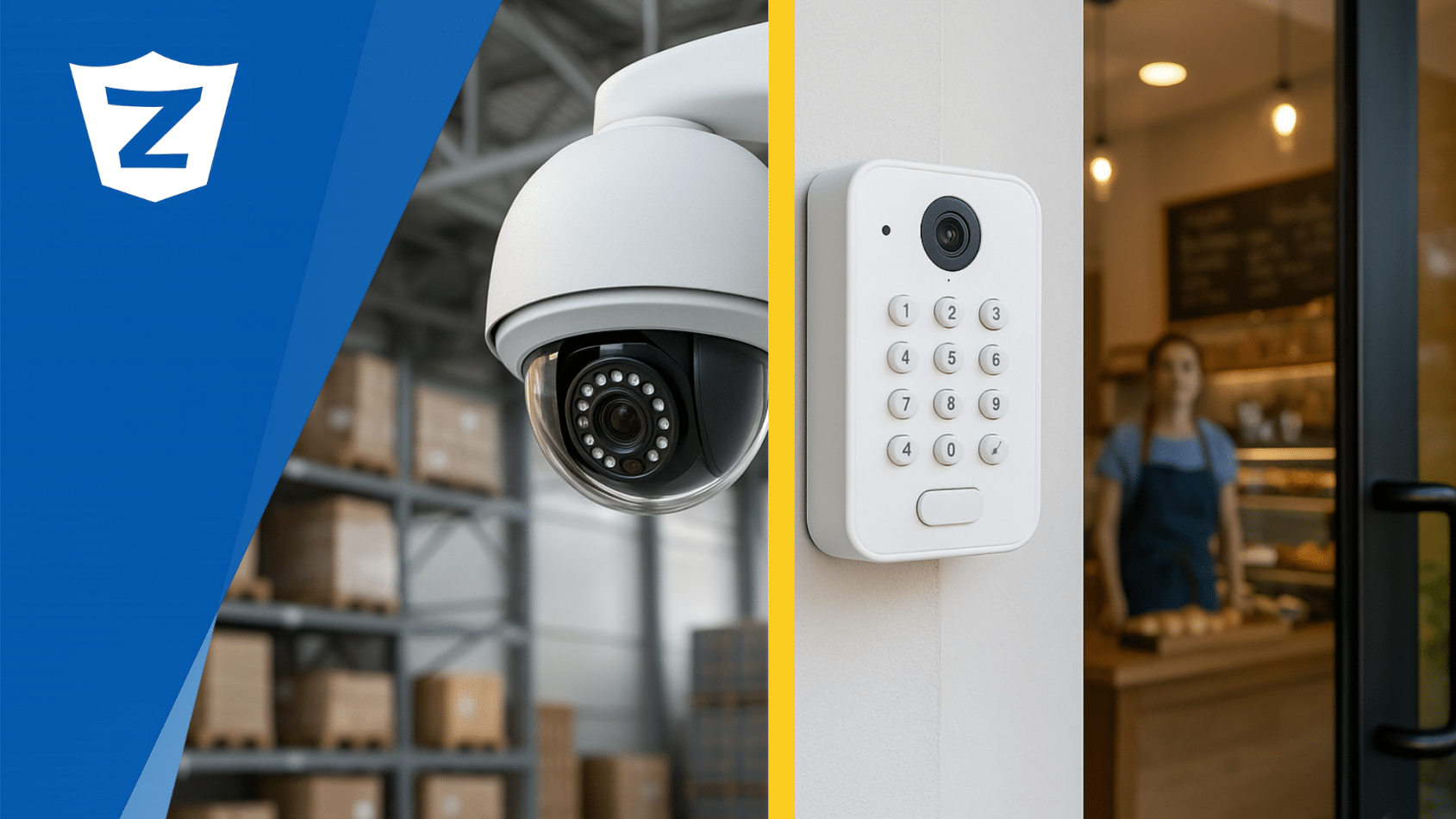
When it comes to protecting your business, not all security systems are created equal. A 200,000‑square‑foot warehouse will require different protection than a neighborhood bakery. So, the burning question at hand: how do you know if you need a commercial security system or a small business security system?
In this guide, we break down the key differences, link you to deeper resources tailored to your business type, and help you make a confident, informed choice.
Why It Matters
The right security system provides protection for your people, assets, and peace of mind. While under-securing exposes you to greater risk, overshooting your needs will simply add unnecessary cost. Understanding the differences between commercial and small business systems allows you to tailor your security investment wisely to balance both cost and safety. These general guidelines will help you know which system is the right fit for your business.
Choose a Small Business System If You:
- Have fewer than 10 employees
- Prefer mobile-friendly, self-monitoring features
- Have a single location
- Want to keep costs manageable
Choose a Commercial System If You:
- Operate multiple locations or large facilities
- Manage high-value equipment or inventory
- Require integration with access control, fire detection, or cybersecurity
- Must meet stringent regulatory or insurance standards
Still not sure which system is best for you? This chart clearly breaks down the differences between each system–one feature at a time.
Commercial vs. Small Business Security Systems: At-a-Glance
| Feature | Commercial Security Systems | Small Business Security Systems |
| Property Size | Large facilities, warehouses, multi-site operations | Small offices, storefronts, single-location businesses |
| Installation | Professional, often hardwired | DIY or simple professional installation, usually wireless |
| System Complexity | High — multiple integrated systems | Low to moderate — basic surveillance and control |
| Monitoring | 24/7 professional monitoring, control stations | Self-monitoring via mobile, optional professional monitoring available |
| Access Control | Biometric, keycard, or credential-based systems | Smart locks or basic keypad access |
| Integration | Fire alarms, cybersecurity, environmental sensors | Basic video and alarm system integration |
| Video Recording | Continuous, large-scale storage required | Motion-activated or event-based recording |
| Cost | Higher — equipment, installation, and monitoring fees | Lower — flexible pricing, scalable packages |
Specific Security Considerations for Different Industries
The precise industry of your business may impose specific security needs. These varying demands should be taken into account when determining whether you need a commercial or small business system. Here is a look at a few different industries and some security considerations pertinent to each.

Restaurants
- Security Cameras
In addition to enhancing restaurant safety, security camaras serve as a vital resource for managers. They permit surveillance on customer service and food preparation to ensure all necessary standards and protocols are being met. - Environmental Monitors
Environmental monitors are another important component of a comprehensive restaurant security plan. While all businesses require fire and carbon monoxide alarms, these are additionally vital in restaurants–where stoves and ovens are in constant operation. Furthermore, temperature monitors can provide notice of potential problems with fridges and freezers prior to the spoiling of food, protecting both your customers and your bank account. - Access Control: Maglocks
Just a few seconds away from the kitchen can bring plates from perfectly toasted to burnt past the point of edible. Electromagnetic door locks allow employees to remotely grant delivery persons entrance, ensuring an efficient and organized workplace without sacrificing meal quality.
For more restaurant-specific security information, including strategies for hardware placement and tech integration, check out our guide to enhancing restaurant safety and operations.
Retail Stores
- Stockroom and Pinhole Security Cameras
While having highly visible security cameras, or even dummy cameras, on the sales floor is a great way to deter shoplifters, over 75% of employees admit they have stolen from their employer. Stockroom security is imperative, as employees may too often be tempted to take an item from excess inventory while out of sight of their customers and coworker. If you suspect you have a potential employee thief, pinhole cameras can be valuable assets in catching them in the act. - Panic and Hold-Up buttons
The nature of retail stores require that customers be in close proximity to cash registers and the employees who operate them. This increased proximity, especially in smaller retail stores where only one or two employees are on shift at any time, can increase temptation to threaten employees in an attempt to access the cash in the register. Panic and Hold-Up buttons, hidden near the register, allow employees to swiftly and silently alert authorities to break-ins and hold-up situations. - AI Analytics
One of the latest technological advances in security systems is AI-powered video analytics, which not only keep your business more secure by identifying suspicious activities such as loitering but also track customer behavior patterns such as dwell time, movement, and interaction with products–all of which provide valuable insights into customer preferences and shopping habits.
Learn more about securing your retail store, including security benefits you might not have considered, in this article.
Construction Sites

- Mobile Surveillance Trailers
With the temporary nature of construction sites, the lack of infrastructure for traditional security components, and the ever-evolving project landscape, securing a construction site can feel daunting. That’s where mobile surveillance trailers come to the rescue. They have solar panels to self-supply electricity, as well as a mobile nature to be moved as the project progresses. In combination with the latest in camera technology, including thermal imaging, this will keep a worksite secure even when not monitored physically. - Wireless Outdoor Motion Detectors
With crews working during the day, and often no locked doors to protect the project and valuable equipment at night, construction sites are a common target for trespassing and vandalism. Wireless outdoor motion detectors can notify you of potential trespassers or vandals, without needing to be hardwired into any system or causing you to worry about exposure to the elements. Some even offer motion-activated lights or audible alarms to scare off intruders. - Signage
Simply knowing there is a security system in place is enough to deter most thieves, trespassers, or vandals. Signs advertising your use of a security system are inexpensive, allowing you to purchase and place them frequently along fenced perimeters, no matter how large your site and perimeter may be.
Want more information on keeping your construction site secure? Read our five tips for construction security.
Self-Storage Facilities
- Access Control: Mobile Devices as Credentials
When it comes to storage facilities, many customers have only a very temporary need. This results in a frequent turnover of customers that can complicate security. When coupled with the potentially hundreds of customers at any given time, the use of physical keys or keycards is simply not feasible. Access control keypads are a potential solution, but encourage customers to find ways of propping security doors open for convenience–creating further risk. Certain control access readers, such as the Prodatakey Touch Reader, allow users to keep their phone in their pocket for a hassle-free entry through simply tapping the reader. Furthermore, mobile credentials are easily removed from the access control database as customers leave, eliminating the need to worry about changing codes. - High-Resolution Parking Lot Cameras
As customers transport their belongings to and from their units, their vehicles are often left unattended, vulnerable to theft or damage. You can give your customers peace of mind by placing high-resolution security cameras in parking lots as well as inside the facility itself. - Humidity Sensors and Leak detectors
Many customers seek out climate-controlled storage to protect their valuable belongings, and while thermostats can regulate temperatures, if a unit’s humidity gets too high, it can be disastrous to many stored items. High levels of rain, roof damage, broken windows, burst pipes, or customers improperly storing liquids in their private units can all raise humidity levels to surrounding units. However, humidity sensors and leak detectors can notify you of any abnormal moisture levels, allowing you to act promptly before serious damage occurs.
Want to see what else your storage facility security system might be lacking? Check out our comprehensive guide to self-storage security to find out.
Warehouses
- Zone-based Intrusion Detection
Warehouses are large and often segmented (e.g., receiving, storage, packaging). Multi-zone alarm systems that monitor specific areas independently can provide alerts that identify which zone was breached, enabling faster response. - Inventory-Integrated Video Surveillance
Warehouses often suffer from internal theft or inventory discrepancies, making video a crucial auditing tool. High-resolution cameras are important for capturing aisle-level details, while making sure your surveillance system can integrate with WMS (Warehouse Management Systems) will allow you to correlate video with inventory movement and provide time-stamped footage linked to specific picking, packing, or shipping events. - License Plate Recognition
Loading docks are high-risk areas for theft, especially during busy hours or after dark. A dedicated license plate camera can automatically capture license plate information for every truck or vehicle pulling up to a loading dock, along with a timestamp and specific location details.
If you’re interested in warehouse security, here are seven ways a top-notch warehouse security system can benefit your business.
How Zion’s Security Supports Your Industry
These are only a few examples of the kind of industry-specific needs a security system should be tailored to meet. At Zion’s Security, we specialize in creating customized security systems to fit the needs of individual businesses in every industry, whether it’s a single storefront or multi-site commercial operation. We also make sure each system is scalable to grow right along with your business
So whether you need to deter shoplifting, protect sensitive data, manage staff access with audit trails, or anything else, our team is ready to provide your free expert consultation with industry-specific insights. We also provide professional installation with reliable ongoing support. If you’re ready to invest in your future, contact us today and let us help you choose the security system that’s right for you.
No Comments